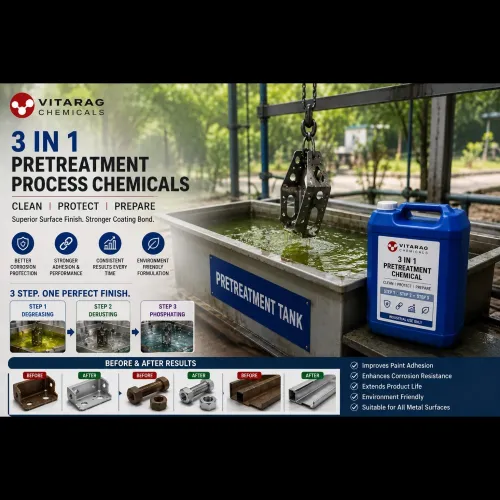

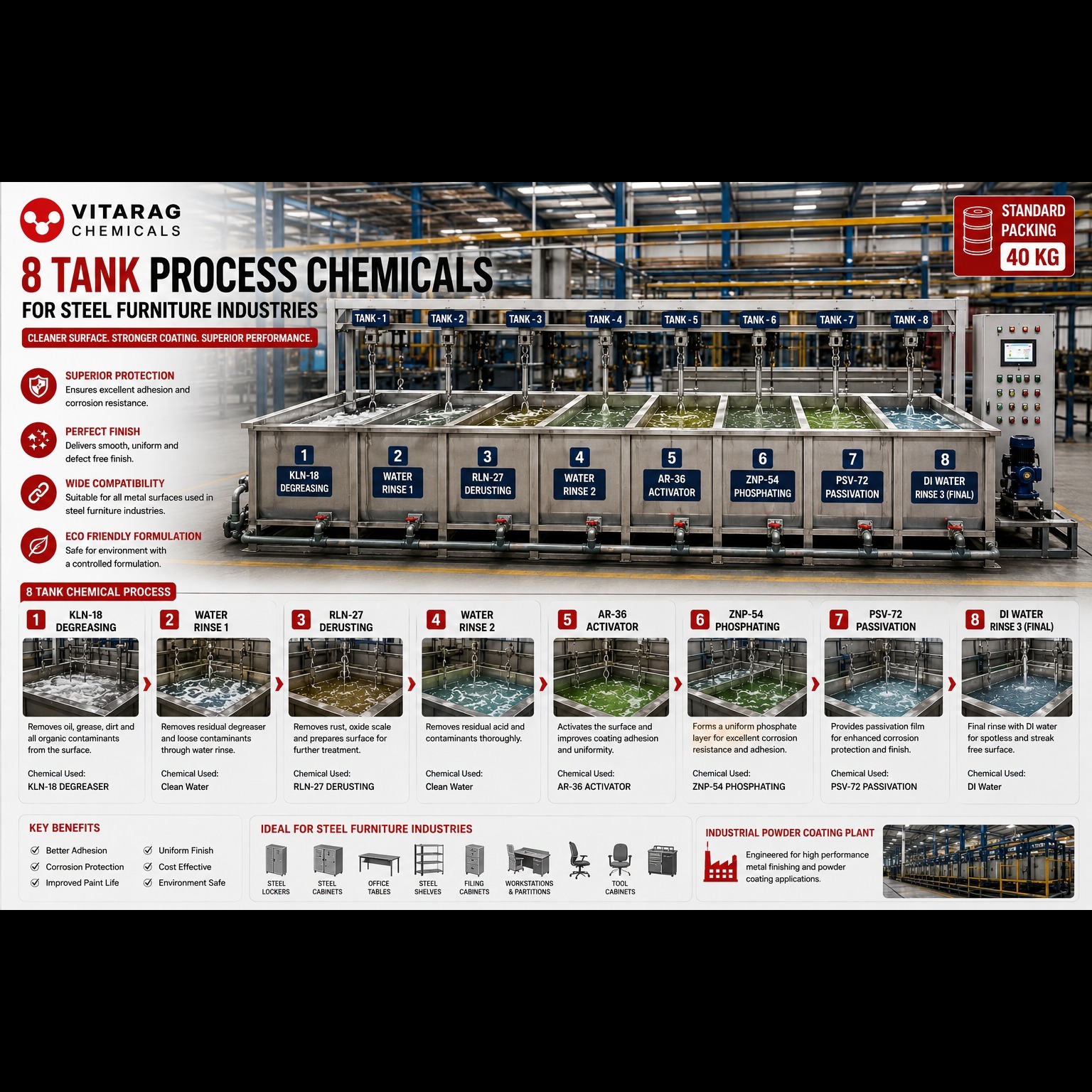
- The 8-tank process is a chemical surface-treatment process used before painting steel furniture such as office tables, chairs, cupboards, filing cabinets, racks, and metal beds.
- Its main purpose is to remove oil, rust, and dirt from the steel and create a clean surface so that powder coating or painting adheres properly and resists corrosion.
1. Typical 8-tank process sequence
Tank 1 — Degreasing
-Removes oil, grease, and machining dirt from the steel surface.
-Typical chemical: Alkaline degreaser
Tank 2 — Water Rinsing
Removes residual degreasing chemicals and loosened dirt.
Chemical: Clean water
Tank 3 — Derusting / Pickling
Removes rust and scale, when required.
Typical chemical: Approved inhibited acid pickling solution
Tank 4 — Water Rinsing
Removes acid residues and dissolved contaminants.
Chemical: Clean water
Tank 5 — Phosphating
Creates a conversion coating that improves paint adhesion and corrosion resistance.
Typical chemical: Iron phosphate or zinc phosphate formulation
Tank 6 — Water Rinsing
Removes excess phosphate solution and soluble residues.
Chemical: Clean water
Tank 7 — Passivation / Final Treatment
Helps improve corrosion resistance and the quality of the treated surface.
Typical chemical: Compatible passivation or post-treatment product
Tank 8 — Final Rinse / Special Rinse
Depending on the process, this may be a final clean-water rinse, DI-water rinse, or a specified seal rinse. The parts are then dried before painting.
Chemical: DI water or specified final-treatment solution